Wednesday, 26 March 2014

Benchmarking innovation and entrepreneurship practices in Dublin


Our group in Innovation Academy
YIE staff from Lapland UAS is further exploring good practices on innovation and entrepreneurship ecosystems and this time gained beneficial experiences during benchmarking visits to Dublin. The trip took place on 17-21 March, 2014. The participants were the head of RDI of Business and Culture Marika Saranne, Project manager Eila Seppänen, the leader of InnoBarentsLab (IBL) and project coordinator at the Rovaniemi campus Anzelika Krastina, senior lecturers Tuija Kuisma and Kaisa Lammi. Lessons learnt
Innovation Academy
during the visits will add greatly to further development of InnoBarentsLab and other entrepreneurship support activities within the project.

InnoBarentsLab is considered to be the place where students and aspiring entrepreneurs can work on different innovation projects, developing business ideas, preparing for start-ups, but the main aim is to develop entrepreneurial and innovative mind-sets. Therefore in this benchmark trip we were focusing on similar activities in Dublin.

Bridget Noone, Enterprise Executive introduces to
Trinity College Dublin Entrepreneurship programme
Visiting University College Dublin, Innovation Academy and Entrepreneurship Campus of Trinity College Dublin proved that creating entrepreneurship ecosystem such as IBL and similar is the core for supporting entrepreneurial endeavours. It was mentioned that Dublin is considered as a “Silicon Valley of Europe”. Innovation is seen as integral part of entrepreneurship and  is nurtured and encouraged by the numerous support mechanisms in both institutions. Entrepreneurship Campus of Trinity
Pitching
College Dublin provides post-graduate entrepreneurship education programmes. Additionally whether needed it offers
incubation or access to accelerator programs. The campus
has 16,000 sq.m. of lettable space for small and medium-sized enterprises and provides them for free for half a year or more for the start-ups of their students.

Innovation Academy of University College Dublin is an internationally recognised exemplar of best-practice in innovation and entrepreneurship education. We were lucky to
The poster of the idea
participate in the educational workshops as well as during the pitching of the ideas in Innovation Academy. It must be noted that the students of Innovation and Entrepreneurship programme are coming from different study fields and in one group together works a lawyer, architect, retired military person and a businessman. It was said that the multidisciplinary teams is the core of innovation and during the pitching it was very interesting to see that people can come up with most unexpected solutions to given business
Young entrepreneurs working in the premises
of the Entrepreneurship campus
challenges, and this is exactly what host companies are expecting.

During this trip we gained also new prospectives from Dublin Chamber of Commerce, where we were informed about the practices of implementation of Erasmus for Young Entrepreneurs programme. The programme is aimed to support young entrepreneurs to develop their skills in business management through an exchange in an enterprise run by experienced entrepreneurs in another European country. The host Marion Jammet expressed her believe in the importance of
With Irish students during the workshop
such programme and to the surprise of all confirmed that in their experience there are only success stories, meaning that both – the host company and young entrepreneurs have only benefited from such cooperation across the borders.

Common conclusion of our group is that these visits are of great educational value and extremely inspirational. One of the hosts encouraged us that we are on the right track in terms of promotion of young entrepreneurship in the Barents and that nothing happens overnight. Innovativeness is a way of thinking that we need to spark into our region and therefore we need more projects such as YIE.
In the incubator of students' start-ups

One of the most significant outcomes is a mutual agreement to cooperate between University College Dublin, Innovation Academy and Lapland UAS in the future. Creation of entrepreneurial ecosystem wasa topic for potential future joint project. It is also a good achievement from the sustainability point of view of YIE project outcomes.

Some thoughts and quotes as a reflection of the visits:

  • “Space matters!” It is important to have inspirational space for students where to work at any time of the day.
  • “Creative thinking” + “Entrepreneurship thinking” + “Application to own context” – the core triangle of entrepreneurship educational programmes.
  • Our job is not to advise, but to conceptualize.
  • Entrepreneurship mix of Innovation Academy: Large and SMEs, profit and non-profit – because the world is not a single colour.
  • Train the trainers!
  • Entrepreneurship should not be an academic school, we make people to THINK. Our school is constant debate!
  • Early stage ideation is important.
  • Action based and experience based learning.
  • We teach the opportunity recognition.
  • Entrepreneurship environmental factor matters. You have to have at least one strong supporter from the top administration!
  • There is no shortcut – Trinity College Dublin works 26 years with Entrepreneurships programme and still many things are to be developed. 
At the University College Dublin campus

Friday, 28 February 2014

Good recipes for entrepreneurial cooperation from Business Kitchen


”If you can’t stand the heat, stay out of the kitchen!” they say. Well, few of us Young Innovative Entrepreneurs’ project workers from Lapland University of Applied Sciences took the challenge and headed off to Oulu, Finland to benchmark an intriguing place called Business Kitchen.

We had heard only positive things about the Business Kitchen before, but the innovative entity sort of surprised us, and furthermore, inspired us. As described in their website, ”Business Kitchen is the first place in Oulu which truly brings together different actors from entrepreneurial fields under the same roof, presenting a unique way for making things happen”.

Principal Lecturer Jouko Isokangas from Oulu University of Applied Sciences welcomed us to Oulu and gave us a brief introduction to the history and general principles of the Business Kitchen. Isokangas pointed out that Business Kitchen brings the resources and expertise of the University of Oulu and the Oulu University of Applied Sciences for enterprises to utilize. The aim, of course, is to increase business. At the same time, it allows students and staff to embrace the entrepreneurial orientation.

After the introduction we jumped into the car and took a short trip to the Oulu city centre where the Business Kitchen is located. Quite an excellent location in the middle of everything!

Business Kitchen offers a possibility to utilize the open working space 24/7. The doors are open for everyone on workdays from 8.30 am to 4 pm, and it has more than 1000 visitors every month. Innovative working surroundings enable to organize meetings anytime and anywhere. The focal point of the Business Kitchen though, of course, is the kitchen area.

The list of parties involved in the Business Kitchen is quite impressive as it truely combines just about all the actors that an entrepreneur can benefit from. Here’s a tip what one can find behind the doors of Business Kitchen:

  • Demola Oulu produces demos, innovation skills, entrepreneurship culture, and activates university-business collaboration.
  • Oulu UAS Business Incubator is a service for students and starting entrepreneurs to turn a business idea into a business plan.
  • Oulu Student Entrepreneurship Society, OuluSES, is an open community for students who are interested in entrepreneurship and self-development.
  • Business Blender services are business development services from the Business Kitchen.
  • RIPA Business Services offers students’ knowledge for entrepreneurs’ needs.
  • BusinessOulu is the driver of businesses and industries, and it aims at supporting creation and competitiveness of businesses and success in the Oulu region.
  • Oulun Seudun Uusyrityskeskus is a counseling service for new and newly
    established companies.
  • Oulu Business Accelerator coaches start-ups aiming at rapid international growth.
  • Design Center Servo is a cluster of various actors who aim to develop the business of their customers with the tools of interface design, industrial design and service productizing.
  • A number of Start-up businesses are located in the second floor of the Business Kitchen.
 
For universities’ students the working method is co-creation, and the working teams usually consist of not only students but actors from business life also. As an open innovation environment, Business Kitchen can offer many ways to enhance knowledge and expertise: networking, workshops, international contacts, pitching, learning by doing, sharing thoughts, co-creational working, and the list goes on and on. Business Kitchen is a centre of entrepreneurship for universities’ and the pedagogical point of view has been a priority from the get go as Business Kitchen has been planned and developed.

As we drove back home from this very fascinating visit, one element of the Business Kitchen concept was uppermost in our minds: cooperation. Business Kitchen really brings together not only the universities’ and entrepreneurs but also the actors from city of Oulu. It’s an unique innovation- and entrepreneurial community which gathers people together despite the organizational boundaries. By providing the spaces, different functions and expertise as well as creating ”swarming” and chances to meet people, new business, communities and ideas are automatically born.


Business Kitchen’s way of bringing all the entrepreneurial (support) actors together in cooperation challenges us to think how it could be possible to create an innovative environment in different circumstances. For example, in our sparsely populated regions, the existing operating environments and infrastructure as well as each municipality’s/city’s different business structure, population and already formed collaborations can produce challenges in the Barents region.

What kind of innovative, entrepreneurial cooperation would be needed and possible to organize in the Barents region? And how can we turn those so called challenges into opportunities and strenghts?


P.S. Have you heard about the Polar Bear Pitching 2014 organized on February 7th? Yeah, the brilliant mind behind it can also be traced back to the Business Kitchen. It was unbelievable to learn that the event was held only few months after the original idea of it came to life.


Text and photos:
Minttu Merivirta, Project Planner, Lapland UAS

Tuesday, 25 February 2014

Design Stories and updating activities


A group of Finnish YIE participants and students from Lapland University of Applied Sciences took part in The Stories -seminar organized during the Arctic Design Week 2014 in Rovaniemi on February 20th.

After the seminar an info event was held in which the participants were given some information about the upcoming YIE events and happenings as well as about a chance to get involved with mentoring with the help of YIE.


New approaches to design

The Stories -seminar was about how using the design expertise benefits businesses. The Finnish and international design experts spoke about creativity and the arctic as the resource and advantage of a blooming business.

The event kicked off by founder and managing director of SeosDesign, Antti Pitkänen’s presentation about his recent work as the project manager in the Design ROI -research project. In the project he and his team of researchers from Aalto University set out to develop a methodology and tool to measure the economic impact of design.

Juhana Arkio, who is currently running the Industrial Design team at Wärtsilä, shared his knowledge about industrial design. After that the stage was given to Anne Turula, Customer Service Manager in the Growth Companies Unit of Tekes. She leads the New Customer Team that works in cooperation with company service networks to encourage and spar with Finnish SMEs in the field of innovative activities, and to direct the companies with the most potential to make use of the innovation funding provided by Tekes.

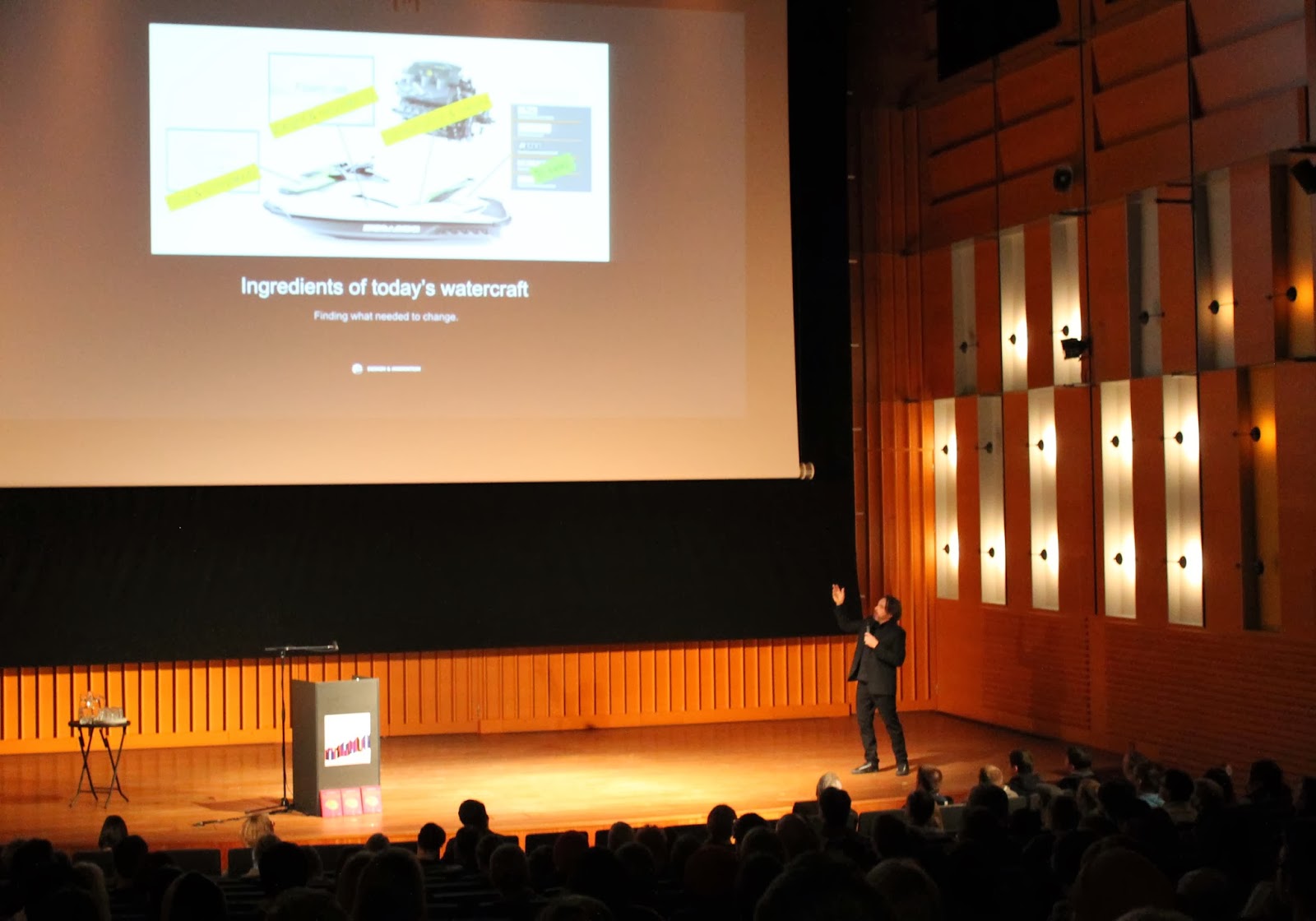
André Côté was one of the key speakers
of The Stories -seminar.

Exterior designer Thomas Stöcker presented Volkswagen’s design process. A quick survey on the way back home revealed that most of the participants thought his presentation was the most intriguing of all!

Designer André Côté from BRP, in turn, discussed especially about the development process of Sea-Doos and Ski-Doos. Côté is Advanced Concept Manager (design portion) and Design Services for Lynx, OE and ROTAX.


Corporate advisor, keynote speaker and writer Tuija Seipell finished the seminar with captivating speech in which she encouraged to separate Arctic Design Week from other
Tuija Seipell closed The Stories -seminar.
design weeks by concentrating on "the arctic". For the past nine years, Seipell has been the senior writer for The Cool Hunter, the oldest design and pop culture blog followed by millions each month.

Also during The Stories -seminar, Kristiina Kaski from Teknova Publishers and Satu Miettinen from University of Lapland presented a new publication called "DesignThinking" (Muotoiluajattelu).

Some of the presentations of The Stories -seminar can be found here.

InnoBarentsLab (IBL) students and entrepreneurs were actively involved in Arctic Design Week’s different organisational activities. They were helping with practicalities during Stories Seminar under the supervision of Heli Huhanantti who is one of our senior IBL members. Outi Lehtiniemi has been responsible for design lounge in Arktikum. Annika Konttaniemi organised a week-long workshop “Hooked” where participants got a chance to learn a new hooking technique and adaptations for that technique. This workshop was included also officially in the ADW programme and has been a great success.


YIE offers a chance to get involved with a mentoring program

After The Stories -seminar, it was time for the YIE Info Event for the participants. A group gathered to spend some time together at the Café in Korundi House of Culture. At first the project manager Eila Seppänen presented the project and the mentoring opportunities it offers for it’s Finnish participants.


Audience had a chance to get more familiar with the mentoring process while audiovisual
Aila Mulari has had a chance to develop her skills
by working together with a mentor.
producing student Aila Mulari from Lapland University of Applied Sciences shared her experiences about being a mentee. She highlighted that mentoring is way more than just consulting. By participating in mentoring programme she gained a lot of knowledge outside the classroom. Aila’s short film “Louhi” was written and filmed as a part of mentoring program.


Communications coordinator Minna Miettunen from The Regional Organization of Enterprises in Lapland (Lapin Yrittäjät) explained how to get involved in YIE's mentoring programme in the Lapland area. She pointed out that mentoring benefits both parties; as young entrepreneurs may have better knowledge of today’s requirements of business in web environment, the experienced entrepreneurs can share their many years’ expertise. In this way a mentee can also teach a mentor through open dialogue.
Jari Kunnari shared information about
existing mentoring programme.

Project manager Jari Kunnari from Rovaniemi RegionalDevelopment Agency Ltd (Rovaniemen Kehitys Oy), in turn, discussed about their existing mentoring programme. In their company business advisors find mentors if a young entrepreneur seems to be in a need for one. He mentioned that usually mental support is the most important thing entrepreneurs are looking for from mentors. According to Jari there's especially need for more mentees!


A lot of cross-border activities coming soon!

Anzelika Krastina from InnoBarentsLab (IBL Finland) shared information about upcoming cross-border events organised by IBL. InnoBarentsLab is a platform for students and young entrepreneurs to do business projects and experience entrepreneurship.


Anzelika and IBL student Samir Younes invited everyone to the Cross-border seminar on 8th May in Rovaniemi! The theme of the seminar is Creative entrepreneurship in the North - 
Anzelika Krastina and Samir Younes presenting
IBL activities (photo by Outi Lehtiniemi).
Crossing the Borders of Our Imagination. Another big event coming up soon is the Business camp in Murmansk from 19th to 23rd May 2014. The aim of the Business camp week is to explore the markets and cooperation across the border and a total of 10 businesses will be chosen to take part in the program.

Last but not least it was time to look ahead for the beginning of the summer, more specifically, to Barents Reunion on 3rd-4th June in Haparanda-Tornio, and Barents Business Festival that YIE organizes in addition to the main event. Quite appropriately, the theme/topic of the Barents Reunion 2014 is "Barents youth and young entrepreneurship".


Laplans UAS's R&D Manager Marika Saranne invited all the participants to join the
Elina Stoor is a part of the planning team of
the Barents Business Festival.
Barents Business Festival that will be a great showcase for the entrepreneurial knowledge and skills in the Barents region. Young and aspiring entrepreneurs get once again a chance to meet influential people from the area. Entrepreneur Elina Stoor from iLme innorooms pointed out that the planning of the Barents Business Festival is still going on, so all the good ideas about the event are more than welcome! To get more information, follow our Facebook-page.


Monday, 18 November 2013

1st-2nd of November, Matchmaking Conference in Kirkeness...

The Kirkenes Conference is a part of the ENPI Kolarctic project called Young Innovative Entrepreneurs. A project where the overall objective is to support economic and social development of the Barents region by facilitating innovative entrepreneurial initiatives by young people in order to contribute to the development of the employment and entrepreneurship in the region. The dissemination of project results to a wider public in the region will support the development of multilateral involvement of the regional actors and thus securing the support for the project activities and its sustainability
The conference gathered 77 participants from all four Barents countries. Most of them already running their own business or planning to do so within a short period of time. In the opening speech given by Rune Rafaelsen of the Norwegian Barents Secretary, he noted that there were a lot of aspiring female professionals present. Actually were more than half of the participants female. A mix not often seen in the male dominated Barents business sphere.
The conference was built around two main topics; human centered innovations through design thinking and pitching your ideas. Federico Lozano started the two day program by introducing the participants to the concept of design thinking, before bringing them through an exciting day consisting of three different sessions. Session 1:  Empathy & Need Finding, Session 2:  Ideation and Session 3:  Rapid Prototyping & Define. Through these three sessions participants learned how to produce rough, rapid prototypes, elicit useful feedback, and iterate.  We also explored prototyping for less-tangible services and processes through role-plays and storyboards.
Innovative products and services are not enough to ensure your company’s success. Everyone needs a simple and compelling way to explain what they do. It's the key to successfully prospecting networking events, chance meetings and parties for new business. But unfortunately the way most people explain themselves comes off self-indulgent and boring resulting in wasted conversations and fruitless encounters. Steinar Korsmo from Seed Forum taught the participants how to quickly and simply define their, profession, product, service, organization or event and its value proposition to their products to investors, customers and partners.
The conference results were astonishing. The participants answered that they increased entrepreneurial competence, increased business competence and increased innovative competence. They also reported that they extended their business network by participating in YIE.